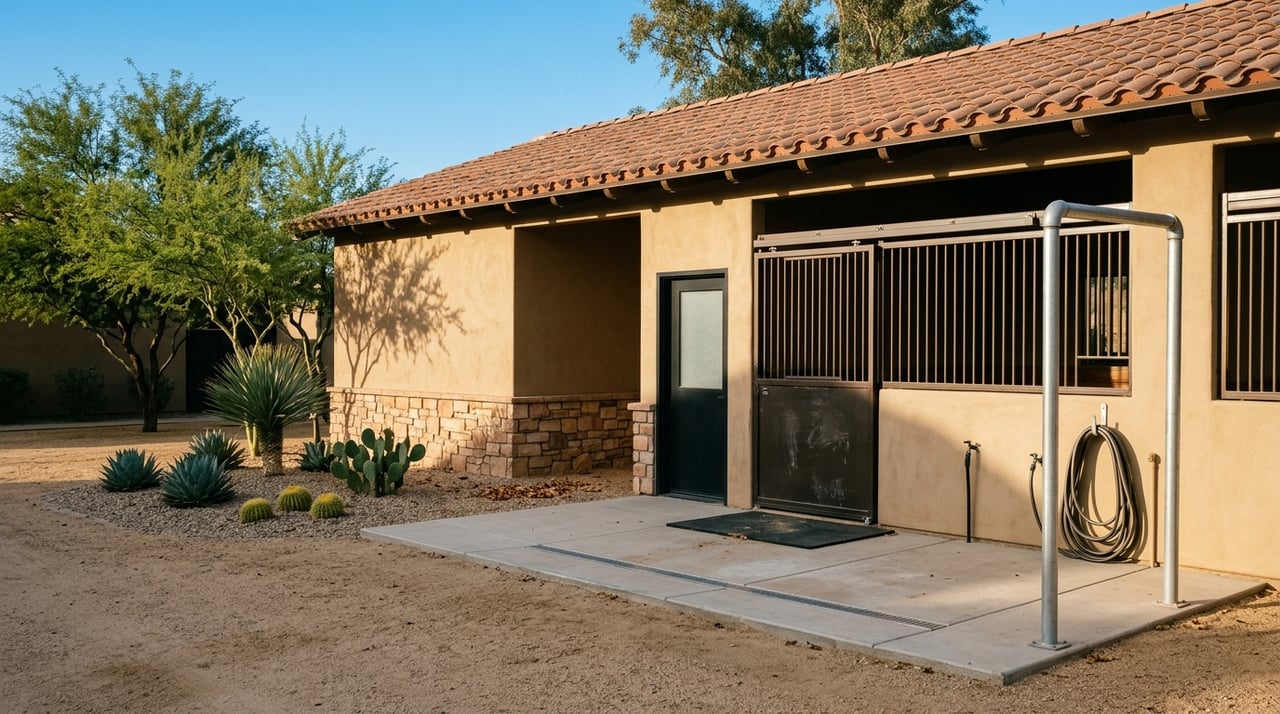
What To Know About Equestrian Properties in Cave Creek
April 16, 2026
April 16, 2026
If you are searching for an equestrian property in Cave Creek, it is easy to focus on the fun parts first: the arena, the barn, the trail access, and the mountain views. But in this market, the details behind the property matter just as much as the lifestyle. Zoning, water, floodplain rules, septic, and site layout can all affect how you use the land and what it may be worth later. This guide will walk you through the key things to check so you can buy with more confidence. Let’s dive in.
Cave Creek is one of the few places in the North Valley where horse property is part of the local identity, not just a niche option. The town notes that its multi-use trail system connects riders to Cave Creek Regional Park, Spur Cross Ranch Conservation Area, the Tonto National Forest, the Maricopa Trail, and Desert Foothills Land Trust properties, which helps explain why so many buyers look here first for horse-friendly living. You can explore the town’s trail network on the Cave Creek trails page.
That said, not every large parcel is automatically horse-ready. In Cave Creek, your ability to keep horses, add improvements, or expand existing facilities depends heavily on zoning, acreage, and site constraints.
For most buyers, zoning is the first thing to verify before getting attached to a property. Cave Creek states that ranching and keeping horses or other livestock is a right for owners of at least two contiguous acres in a Desert Rural, or DR, zone. The town’s prospective buyer guidance is a smart place to start when confirming those basics through Cave Creek’s Notice to Prospective Property Owners.
The current zoning code lists several DR categories with different minimum lot sizes:
These labels matter because private ranch uses such as boarding, breeding, equine training, and equine lessons are addressed in the zoning code. If you are considering a larger-scale operation, the rules shift again. The town code says commercial ranches require at least five contiguous acres.
A parcel can look generous on paper and still have less usable space than you expect. Cave Creek’s zoning rules note that total lot disturbance includes accessory uses, driveways, and septic systems, which means your buildable and usable area can shrink quickly.
That is especially important if you want room for a barn, corrals, trailer access, turnouts, or an arena. A property may meet the acreage threshold for horse use, but still feel tight once setbacks, drainage patterns, and utility placements are factored in.
If a listing mentions horse facilities, do not assume every improvement is placed where it should be. According to the town code, barns, corrals, horse shades, and other private ranch uses are restricted to DR zones. The ordinance also says that in DR areas, fences including corral fences generally must be set back 12 feet from property lines, and manure storage must be at least 60 feet from property lines. You can review these standards in the Cave Creek residential zoning ordinance.
Horse trailers are also treated as an accessory use in DR zones, which is another reason site planning matters. If the property is already improved, you will want to confirm whether the existing layout fits current rules and whether any future changes could trigger town review.
Direct trail access is a major draw in Cave Creek, but it should always be verified. The town says many properties either abut or are crossed by trails, and that motorized vehicles are prohibited on trails or in washes. If a property’s value to you depends on ride-out access, ask for clarity on where the trail connections actually are and whether there are easements or restrictions involved.
Drainage is just as important. Cave Creek warns that roads, trails, and washes can become impassable during extreme weather, and Maricopa County requires a Floodplain Use Permit before building, grading, filling, installing walls or fencing, or making other man-made changes within a designated floodplain. You can review those permit requirements through the Maricopa County Flood Control District.
If your riding plans include nearby state trust land, that may require a separate recreational permit from the state land department. This is one of those details that can affect how you use the property day to day, so it is worth verifying early.
Utilities are one of the biggest surprises in Cave Creek horse property. The town says its water service is split between two systems. The Cave Creek Water System starts with CAP surface water treated at the town plant, while the Desert Hills system relies on groundwater and is supplemented by CAP water through an interconnect. The town also notes that water rates may be higher than in some other areas and uses base-plus-volume billing. More details are available on the Cave Creek Water System Facts page.
For equestrian buyers, that means you should ask not just whether there is water service, but what kind. If a property uses municipal water, Desert Hills water, a private well, or a shared well, your costs, responsibilities, and due diligence may look very different.
Cave Creek also notes that not all areas have sewer service, and where sewer is available, hookup may be mandatory and fee-based. If the property instead relies on septic, that becomes a major part of your inspection process.
Private and shared wells need extra review. Cave Creek’s buyer notice explains that if a property uses a private well, the Arizona Department of Water Resources requires a Notice of Intent to Drill before drilling or modifying a well, and the department’s Well Registry can be used to look up registry information. The town also points buyers to state health guidance for private well water-quality testing, while the University of Arizona notes that well owners are responsible for upkeep and water quality.
Shared wells require even more care. Cave Creek states that shared well agreements are not regulated by ADWR and are generally not found in imaged ADWR records, so buyers should verify the recorded agreement with the county recorder. In practical terms, you want to know exactly who shares the system, who pays for maintenance, and what happens if repairs are needed.
If the property is on septic, Arizona has a transfer process that you should not overlook. Cave Creek says the state transfer program requires a qualified inspection within six months before transfer, the seller must provide the Report of Inspection and system documents, and the buyer must file the Notice of Transfer within 15 days after closing. You can review the state requirements on the Arizona Department of Environmental Quality transfer inspection page.
For horse properties, this matters because septic placement can affect where you can add future improvements. It can also reduce the amount of truly usable land on a parcel.
Some buyers want more than a private setup. If your plan includes boarding, training, or lessons at a larger scale, be careful not to assume every horse property fits that use. Cave Creek’s code distinguishes between private ranch uses and commercial ranches, and the commercial standards are more demanding.
For example, the code states that commercial ranches can include features like polo fields and riding arenas used for events such as roping or horse shows. It also says commercial ranches require at least five contiguous acres, access to at least a designated collector road, and prefer on-site unpaved parking. If your intended use is business-related, those standards should be reviewed before you make an offer.
Cave Creek is already a high-price market before you add equestrian features. According to Zillow’s Cave Creek home values data, the average home value is $1,031,380, and homes are pending in about 38 days.
The research also shows that horse-ready properties can sit well above the broader market. One current example is a 2.28-acre listing with 3 stalls, a lighted arena, a private well, septic, RV spots, and solar asking $1.895 million. Another nearby 5.62-acre horse estate with a barn, arena, and direct trail access sold for $2.575 million in 2024 and is now estimated around $2.54 million.
The takeaway is straightforward: equestrian improvements can support premium pricing, but resale still depends on usability, condition, and how well the setup matches buyer demand. A large parcel with awkward access, unclear utilities, or nonconforming improvements may not command the same response as a well-planned, truly functional horse property.
Before you move forward on a Cave Creek equestrian property, make sure your due diligence covers the basics and the property-specific details.
Here is a practical checklist based on the town and county guidance:
Equestrian purchases often involve more moving parts than a standard home purchase. You are not just evaluating a house. You are also evaluating land use, access, drainage, infrastructure, and future flexibility.
That is where local guidance can make a real difference. When you know what questions to ask before the inspection period starts, you can avoid surprises and focus on properties that truly fit your goals.
If you are exploring horse property in Cave Creek, Annie Cole can help you evaluate the details behind the listing so you can move forward with clarity and confidence.
May 28, 2026
May 21, 2026
May 14, 2026
May 7, 2026
April 23, 2026
April 16, 2026
April 9, 2026
April 2, 2026
March 26, 2026
Searching for homes and real estate in Scottsdale? You've come to the right place. Curious about Scottsdale luxury properties for sale? So am I!